Announcement:

Posts on this website are general "tips" and nothing more than that and should never be used to make an investment or trading decision. All information should be carefully cross-checked against official sources for accuracy.

Uranium Prices on the up again. Australians companies to gain.

November 10th, 2010

According to TradeTech, jumped US$5.50 to US$57.50/lb.

TradeTech reports the level of spot demand is “exceptionally high”, albeit “predominately discretionary”, meaning investors and speculators are now back in earnest. Real end-users were more inclined to sit back and reassess last week.

Perhaps the hedge funds are beginning to re-enter. Most will remember that in 2006, hedge funds pushed the uranium spot price to US$138/lb followed by a “true” bust.

However despite TradeTech’s observation of the upswing being based on discretionary buying there has been a marked number of articles outlining the future needs of the uranium power plants that are now being either built of planned. Further China appears to be making sure that it doesn’t get caught short with a stockpile build up. That plus the missiles to megaton project coming to an end in 2012 (Russia) 2013 USA seems to be part of the drivers. Certainly we have seen an uplift in the Uranium share indexes both Australian and Global over the last few weeks.

Some of the high gainers include EXT, GGG, AEE and PDN. Each of these have extraordinary drivers: With EXT bringing the world’s second largest mine into production in 2013, GGG having a lovely mix of uranium coupled with the world’s largest Rare Earth Elements deposit, AEE on track towards proving up a billion pounds of uranium with a minuscule market cap and PDN after doubling its reserves and being the first into new production.

Aura adding more uranium

November 8th, 2010

As previously remarked ,Aura Energy ASX AEE has almost as much uranium as Extract resources but is just a fraction of EXT’s market cap. AEE’s main holding is in Sweden where they are on track to prove up a remarkably large resource that may eventually be 4x EXT’s current resource. Adding to its rather obvious attractions to an investor wanting cheap exposure to Uranium,  AEE has just announced that it has hired a drilling rig to explore its West African Reguibat Project in Mauritania, West Africa.

Aura completed the initial drilling of calcrete mineralisation in Mauritania earlier in 2010. The 392‐hole drill programme confirmed the presence of the widespread calcrete uranium mineralisation generally two to four metres in thickness, and locally up to six metres thickness.

Uranium grades and extent of the mineralisation were considered highly encouraging with individual one metre drill samples ranged up to 4056 ppm U3O8.

Extract: BFS for World's second largest Uranium mine in 2011

November 4th, 2010

A month or so I opined it was time to get back into Extract. It seems that the market agreed and those of you that bought in are now being rewarded….

Extract Resources has told investors they will have to wait an extra three months for the long-awaited bankable feasibility study over its Namibian uranium mine.

Extract chief executive Jonathan Leslie told shareholders at today’s annual meeting that the feasibility study would not be released this year as planned but in the first quarter of 2011 instead.

But he said the three-month delay did not mean much, given the scope of the project.

“It’s been a very aggressive timetable,” he told reporters on the sidelines of the meeting.

“I don’t think shareholders will mind the delay. It’s a very large project and a slip of a quarter is nothing.”

He said Extract hoped to start commissioning Husab – formerly known as the Rossing South project – in early 2014 and it would be about an 18 month ramp-up to full production.

With forecast annual production of 15 million pounds of uranium, Husab would be the second biggest uranium mine in the world.
Extract shares were up 25 cents, or 3.17 per cent, to $8.15 shortly before market close.

extract-strong

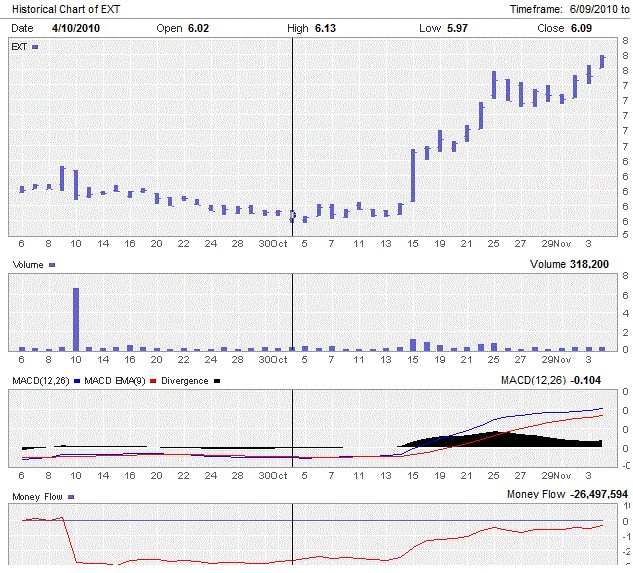
Extract ASX: EXT trend is strongly +ve

October 21st, 2010

I posted about Australia’s Extract Energy (ASX : EXT) (TSE : EXT) very large Uranium project destined to become one of the world’s largest uranium mines in an increasingly uranium mining friendly country -Namibia. Of note EXT has now start to trend strongly upwards… perhaps due to a flight of uranium capital out of Australia due to the increasingly menacing political outlook or due to it now becoming recognized as one of the world’s biggest uranium deposits… But when you see the “green” trade triangle it is time to take note in my experience
ext-strong-uptrend

Uranium warming up. Best Mkt Cap/Resource opportunity

October 15th, 2010

As a long term uranium investor I like to keep a fairly close eye on several factors including the spot price, the long term price, the direction of the global uranium companies share prices as well as the Australian Uranium Share Price Index and the  global uranium fund’s (GURAF) trend.

Recently we have seen an increase in both the spot and long term uranium price and over the last week a rise in several of the ASX listed uranium plays.

This lead me to have a look at the market caps and JORC resources of our ASX listed uranium plays.

I must admit the results surprised me in that one company in a safe, uranium mining friendly country, has a verified resource (291m pounds) almost equal to Paladin’s but a market cap of $19.6 million compared to Paladin’s 2.8 billion. Extract has slightly bigger resource than Paladin’s and a market cap of $1.5 million. Paladin are mining, Extract probably will be mining in 2011 but that doesn’t really indicate why my “find” is 100 times cheaper. Even more interestingly my “find” has good reason to believe that it will have a resource of around 1 billion pounds of uranium, around 3 times more than Extract current 400m pounds.

Here is what Australian-Shares.com says about my “find“.

Aura Energy (ASX: AEE, “Aura”) is a uranium explorer with projects in Australia, Sweden and Africa. The Company has assembled an exceptional portfolio of properties on three continents, including a major presence in Sweden’s Alum Shale Province, one of the largest depositories of uranium in the world. The Company continues to be very active, with drilling completed on all three continents in 2008.
Aura is a major landholder in the mineralised Alum Shale of central Sweden. The Alum Shale is widely distributed throughout the Baltic States and locally contains exceptionally large resources of uranium, vanadium, molybdenum and nickel.

Aura’s Storsjon Project adjoins Continental Precious Metals’ (TSX: CZQ) Viken Project, which has a published resource of 1.05 billion pounds U3O8 grading 0.017%. This size of resource makes Viken the second largest published uranium deposit in the world after Olympic Dam.
Aura’s considers that it holds approximately half of the uranium field, and anticipates defining resources of similar size to Viken in its Storsjon Project.“

I can hear you thinking it is the grades dummy:  “The resource, using a 100ppm U3O8 cut-off, gives the Häggån Project a contained uranium content of 291 Mlbs. This resource places Häggån seventh within the ten largest undeveloped uranium resources that are compliant with ASX or TSX requirements”

But from their latest metallurgy results published yesterday (14th/October/2010) Their  tank leach metallurgy seems to be promising… They also  have a massive amount of Vanadium, some Zn, Ni, Mb.

“The first metallurgical test results for Aura’s Häggån Uranium‐Molybdenum‐Vanadium Project in Sweden gave high uranium recoveries using conventional treatment methods:

  • Conventional acid leaching achieved uranium recoveries of up to 93% from Aura’s samples
  • Majority of uranium extraction was achieved in first 12 hours of leaching”

AEE are now looking at enhancing the leach process using a biological  model

“Aura commenced bioleaching testwork with the Parker Cooperative Research Centre for hydrometallurgical research in Perth, Western Australia in late 2009. Bacterial cultures have been established from three sources: the ore; waters from the project area in Sweden; and from a coal mine in Western Australia.

Initial work demonstrated improved extraction rates of uranium, molybdenum, nickel and zinc using bacteria, relative to samples without bacteria. Consequently these initial results indicate the Alum Shales within the Project are likely to be amenable to bioheap leaching.

This method of extraction will potentially provide a low capital and operating cost treatment route.
These preliminary small‐scale tests are encouraging, confirming that bacterially‐assisted leaching of uranium from the mineralisation may be technically feasible.”

So a very large resource possibly in the world’s top four, a proven tank leach process with a throughput time of around 12 hours and a possible much greater efficiency with a biological modification all for 1/100th of EXT’s current price. WOW!

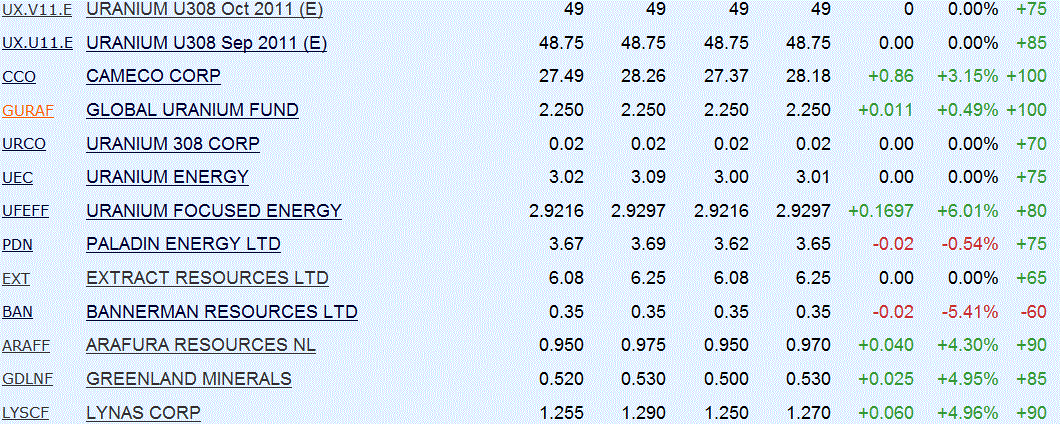
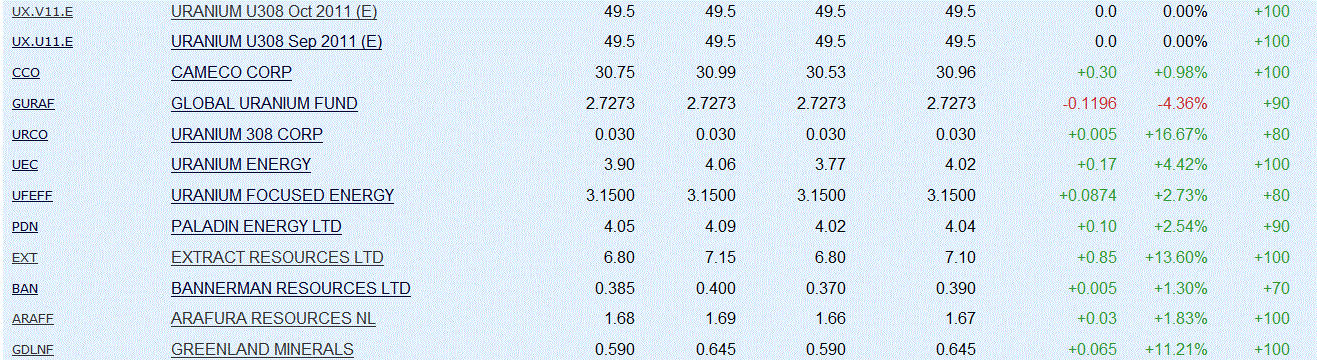
Many of the uranium plays are looking healthy according to marketclub:
mc-uranium

Canada Relaxing Foreign Investment Rules in the Uranium Sector
URANIUM: Up another $2.5!
Aurora Energy after the vote!
Cigar Lake: 2011 at the earliest!
China to Build 28 More Nuclear Power Reactors by 2020

Disclaimer: I hold AEE and EXT and of course : Comments on this blog should never be taken as investment advice


Paladin doubles Namibian mine reserves

October 4th, 2010

Paladin doubles Namibian mine reserves
October 04, 2010 09:19 AM

Paladin doubles Namibian mine reserves

Paladin Energy Ltd (ASX:PDN) has announced its reserves at the Langer Heinrich mine in Namibia have doubled to 134 million pounds.

The uranium miner says drilling was carried out across the full extent of the deposit, resulting in a highly successful upgrade of ore reserves and mineral resources.

So much so that Paladin says the increase justifies the planned Stage 4 expansion for which a feasibility study is currently underway.

Paladin says the additional mine production is essential to meet increasing worldwide demand and says it is in an excellent position to capitalize on the market opportunities.

Paladin Energy recorded a net loss of $63.12 million in the 2010 financial year.

The doubling of the reserves in Namibia might take some of the sting out of their recent knock back for the Angela Pamela JV with Cameco mine in the Northern territory?

Global Uraniun Fund strongly +ve trend

September 25th, 2010

What a change a few months have made. We are now seeing a strong positive trend emerging across many of the Uranium plays. The GURAF is one leading indicator for the re-emergence of the sector. It indicates it is near time to be getting back on board IMO.

guraf-up

Even though the Australian Uranium Share Index (23/9/2010) still is going sideways there seems to be a better outlook emerging for overseas uranium plays. Personally I think many investors have sidelined the Australian based plays as their is substantial GREEN risk with our finely balanced parliament giving the Greens a great deal of power.

mkt-club-uranium-9-2010

Extract and Kalahari joint venture agreement between North River

September 22nd, 2010

Kalahari Minerals (LON:KAH) chairman Mark Hohnen believes that the joint venture agreed between North River Resources (LON:NRRP) and Extract Resources (ASX:EXT, TSX:EXT, NSX: EXT) can deliver a ‘considerable value uplift’ for both associates. Kalahari owns more than 40% of both companies.

North River and Extract will work together to develop three uranium exploration licences in Namibia, near Extract’s world-class mine development project – the Rössing South deposit on the Husab Uranium Project. Read article

Namibia or Australia to fill world Uranium gap?

September 17th, 2010

I wonder if the writer of the commentary below knows about Australia’s ASX listed companies with Namibian projects? (EXT, BMN, PDN etc)

These are are world class projects and far outweigh what Australia is likely to produce given the current internal Australian uranium political dissonance.

AUSTRALIA can play a key role in meeting the global shortfall in uranium supplies, but only if existing mines are expanded and new ones brought on board quickly, Adelaide-based uranium explorer Toro Energy says.

With uranium emerging as a worldwide energy solution, Australia will play its part through expanding existing mines and discovering and developing new deposits, Toro Energy says.

Managing director Greg Hall told the World Nuclear Association in London that while $US3 billion ($A3.2 billion) and been spent globally on uranium exploration since 2003, new discoveries had been limited.

“There have been some new, globally significant discoveries and there will be a few more, somewhere we believe in the order of five new globally significant uranium discoveries are likely between 2003 and 2020, Mr Hall said.

However, it will be on average between eight to 15 years before any of these opportunities move from discovery to stable production.’

Note that EXT will be in production in 2012 with one of the world’s largest mines

While that presented opportunities for Australia, Mr Hall said local producers could miss out on global opportunities unless new projects were brought on through the approval and feasibility process amid the right pricing environment.

With high prices Australia could be producing 7000 tonnes of additional uranium oxide by 2015, rising to an additional 14,000 tonnes by 2022, Mr Hall said.

Toro has just completed the trial mining test pit at its Wiluna project in Western Australia with production expected from 2013.” http://wotnews.com.au/view/5583999/

EXT 12% rise on TSX

September 17th, 2010

Interesting to see that EXT popped 12% on the TSX overnight but the movement here in Australia is just under .5%. Makes EXT 10c less than Canadian price.

Makes me wonder if people here in Australia are just avoiding uranium in view of the new anti-uranium sentiment. (Perhaps they do not know that EXT is in Namibia?)