Announcement:

Posts on this website are general "tips" and nothing more than that and should never be used to make an investment or trading decision. All information should be carefully cross-checked against official sources for accuracy.

GGG and BMN

April 30th, 2012

Two ASX listed “Uranium” companies released their quarterly reports today. Both have good mineralogy and processing flow sheets.

BMN is a “pure” play Namibian Uranium explorer and GGG is a multi-metal Greenland Uranium, REE and Zinc explorer. Both have some similarities as they will be both able to produce large amounts of Uranium for many decades.

BMN: Proved and Probable Ore Reserves totaling 279.6 million tonnes at an average grade of 194ppm U3O8 for 119.3 Mlbs of contained U3O8; Market Cap AUD$60m (30/4/2012)

GGG: Project global resource base expanded to 861 Mt, containing 512 Mlbs U3O8, 340,000 t heavy REO, 750,000 t yttrium oxide, 4.4 Blbs zinc; Market Cap AUD$208m (30/4/2012)

Both have some country risk but an optimist would probably be comfortable with both. But it would seem that with GGG you get the world’s largest REE resource plus 4.4Blbs zinc for free.

And if you have no interest in REEs but would like the ASX’s largest uranium explorer, by resource, with a very low country risk and a minimalist market cap of AUD$22m then you’d probably like to have a very close look at AEE.

I hold GGG and AEE

The world's top 10 undeveloped uranium resources (by size)

February 16th, 2012

aee-resources

The Häggån Project covers 110 square kilometers of the Storsjön District in Sweden
and forms part of an enormous uranium field, where the uranium occurs in black
shales, and currently holds a JORC inferred resource of 631 million pounds uranium.
There is potential for further large increases in resources with thick near-surface
mineralisation

But what excites me as an investor is the tank bio-leach process that has a very fast turnaround and high rates of extraction plus one of the lowest enterprise values/resource ratios of any uranium JORC deposit.

Aura Energy Australia's second largest Uranium resource – strong +ve economic results confirmed

February 8th, 2012

STRONG POSITIVE ECONOMIC RESULTS CONFIRMED
FOR HÄGGÅN – MOVING TO PRE-FEASIBILITY
HIGHLIGHTS
Independent consultants have completed the first Scoping Study for the Häggån
Project:
 Scoping study confirms economic viability for bioheap leach project
 Net Present Value (NPV) – US$1,090M (pre-tax, 10% discount rate)
 Internal Rate of Return (IRR) 47%
 Total life of mine capital costs of US$769 million, including sustaining capital
 Payback in approximately 4.3 years, or less than a fifth of current project life
 Operating costs of US$36/lb uranium net of by-products
 Low mining costs – strip ratio of 0.75:1
 Nominal 30 Mtpa operation with a 25 year initial mine life – scope to expand
 Target initial annual production of 6.6 Mlbs uranium, 14.8 Mlbs nickel and 3.6
Mlbs molybdenum; target would place Häggån in the top 10 uranium mining
operations
 Sweden – excellent jurisdiction to develop a very long life mining operation
 Similar-sized multi-metal bioheap leach operation in neighbouring Finland
 Next-step: PRE-FEASIBILITY

Uranium supply deficit by 2016

January 25th, 2012

“2016: We have to have supply in the market or the lights will gradually go out in the nuclear system,” said Thomas Drolet, the president of Drolet & Associates Energy Services, during a presentation at Cambridge House’s Vancouver Resource Investment conference on Monday.

A uranium supply crunch is widely anticipated to hit the nuclear industry starting next year as Cold War era sources of uranium dry up. To illustrate the severity of the shortage that the nuclear industry faces, Drolet highlighted 2010 uranium production from mining – 118 million pounds – versus consumption: 190 million pounds.

“You can do the delta difference yourself,” Drolet said, referring to how much of a supply gap miners will have to make up for in coming years.

That uranium is “going to have to come from somewhere,” he said.

The Fukushima nuclear disaster in Japan, Drolet argued, only delayed the onset of the coming pinch on uranium supply. But even in his “downside” analysis the uranium deficit still comes by 2015. http://www.mineweb.com/mineweb/view/mineweb/en/page72103?oid=143915&sn=Detail&pid=102055

About Thomas Drolet

Nuclear Power Generation Post-Fukushima (Tom Drolet) pdf

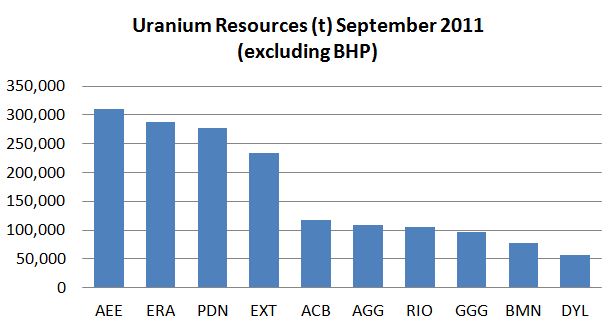
ASX listed Uranium plays by Resource Size updated

January 24th, 2012

We have updated our ASX listed companies sorted by resource size. There has been a fair amount of movement. One of the bigger surprises is one of our very small ($24m) by market cap companies moving into second position below BHP. This could be one of the world’s cheapest very large resources, in terms of market cap to resource size. It certainly is in an interesting position in regard to our ASX plays.
Uranium Resources ASX
Note that the data is from 3Q 2011. Visit http://www.australianuranium.com.au/Australian-Uranium-Stocks-by-Resource.html to find out more

Extract (ASX: EXT) now in play $8.65 AUD

December 9th, 2011

December 9, 2011: Extract Resources Ltd (ASX/TSX/NSX: EXT) (“Extract” or “the Company”) notes the announcement by Taurus Mineral Limited (“Taurus”), an entity
owned by CGNPC Uranium Resources Co., Ltd. (“CGNPC-URC”) and The China-Africa Development Fund (“CADFund”), of a recommended cash offer for Kalahari Minerals plc (“Kalahari”), Extract’s 42.74% shareholder, at a price of 243.55 pence per Kalahari share (the “Kalahari Offer”). The Taurus announcement includes a proposal to make a downstream cash offer to Extract shareholders of A$8.65 per Extract share (the “Extract Offer”), if Taurus receives acceptances of the Kalahari Offer in respect of more than 50% of the voting rights in Kalahari.

Update: 11/1/2012

Update Regarding Proposed Downstream Offer for Extract Resources
January 11, 2012: Extract Resources Ltd (ASX/TSX/NSX: EXT) (“Extract” or the
“Company”) has been informed that the Namibian Competition Commission (“NCC”) has
approved without conditions the possible acquisition of control of Extract by Taurus
Mineral Limited (“Taurus”), an entity owned by CGNPC Uranium Resources Co., Ltd.
(“CGNPC-URC”) and the China-Africa Development Fund (“CADFund”).
NCC consent to the possible change of control of Extract is a condition of the Taurus offer
to Kalahari shareholders (the “Kalahari Offer”), as set out in the offer document posted to
Kalahari shareholders on January 5, 2012.
Taurus has been granted relief by the Australian Securities and Investments Commission
(“ASIC”) to acquire an interest of more than 20% of Extract’s shares provided that, among
other conditions, Taurus makes a downstream offer for Extract (the “Proposed Extract
Offer”). Taurus is required to dispatch offer documentation to Extract shareholders within
four weeks of Taurus having received acceptances of the Kalahari Offer in respect of
more than 50% of the voting rights in Kalahari. The Proposed Extract Offer will only be
conditional upon Taurus becoming unconditionally entitled to shares carrying more than
50% of the voting rights in Kalahari, and standard prescribed occurrences as set out in the
Corporations Act not having occurred.
Extract’s Independent Directors are continuing to review all available opportunities to
maximise shareholder value, and intend to make a recommendation in relation to the
Proposed Extract Offer if and when such an offer is made.

Greenland Energy and Minerals breakthrough

December 5th, 2011

If you have read my earlier posts re GGG you’ll know that once GGG comes on line the world’s Rare Earths and in particular the Heavy Rare Earths future supply characteristics will be changed from deficit to surplus. (Market cap $220m)

Today’s announcement by GGG:

“Greenland Minerals and Energy Ltd (“GMEL” or “the Company”) is pleased to announce that the government of Greenland has amended the Company?s exploration license (EL 2010/02) covering the Kvanefjeld multi-element project such that it is now inclusive of uranium.

This license covers the northern Ilimaussaq complex and includes the world-class Kvanefjeld resource, in addition to emerging satellite deposits Zones 2 & Zone 3 (Table 1). Under the licensing framework in Greenland, the licensee maintains the right to apply for an exploitation (mining) license for all exploitable elements listed on the exploration license. Importantly EL 2010/02 now includes radioactive materials, providing the company with the clear right to apply for the exploitation of radioactive elements along with all other exploitable elements. The granting of an exploitation license will be dependent on establishing an environmentally and socially sustainable development scenario that is economically robust.”

indicates that Greenland Energy and Minerals is now substantially de-risked.

Follow this link to my www.australian-shares.com blog to a list of my earlier posts re GGG.