
Is this a turning point for uranium?
http://australianuranium.com.au/uranium-charts.html
Anyone have a view as to why we are seeing the co-ordinated changes? Just a blip or more to it?

Posts on this website are general "tips" and nothing more than that and should never be used to make an investment or trading decision. All information should be carefully cross-checked against official sources for accuracy.
Is this a turning point for uranium?
http://australianuranium.com.au/uranium-charts.html
Anyone have a view as to why we are seeing the co-ordinated changes? Just a blip or more to it?
$20 billion in uranium waits for Queensland ban to lift
Article from: AAP
Tony Grant-Taylor
July 27, 2009 12:00am
THERE seems little chance Queensland’s uranium hopefuls will see the ban on mining lifted any time soon, and some $20b worth is sitting in the ground.
Which is perhaps a pity for those who support mining for the nuclear fuel. Industry monitor Resource Capital Research’s latest quarterly Uranium Sector Review says: “Industry fundamentals remain strong, underpinning support for the contract uranium price, with (significant) growth anticipated in (the number of) nuclear reactors and (an emerging) risk of a supply shortage mid term (four to eight years).”
Given the strict environmental impact hurdles that any mine that was approved would have to jump, four years would be about the minimum time it would take to get any mine into production.
Federal minister Martin Ferguson’s says mining in the state is “just a matter of time”.
However, Queensland Resources Council chief executive said: “We have about $20 billion worth of uranium in the ground right now in Queensland and we have countries that want to use it.
“The opportunity is a big one in terms of hundreds of millions of dollars’ worth of investment, many hundreds of jobs, including for indigenous people and of course a new source of mineral royalties, which would be nice to have at the moment when the Queensland Government’s running a deficit Budget.”
Mount Isa Mayor John Molony also joined the chorus of supporters, as did former Queensland mines minister Tony McGrady, now an adviser for a uranium explorer.
Cr Molony said thousands of jobs would be created in northwest Queensland alone if uranium mining was allowed.
Cr Molony said Queensland could not afford to turn its back on the sector.
Resource Capital Research said there were 436 nuclear reactors in operation worldwide and 45 under construction.
And as of June 30, it said, another “413 new reactors (were) planned or proposed.
“A total of 71 are expected to be commissioned by 2015.”
In South Australia the proposed Four Mile mine received federal approval last week, and in Western Australia, where a number of developments are moving forward quickly, Mega Uranium’s Lake Maitland trotted out its Japanese customers as it pushed for an early start.
But Queensland Mines and Energy Minister Stephen Robertson isn’t moved.
He said last week that the Government took its longstanding no mines policy to the last election and was still committed to it.
Mining of radioactive material began in Australia in the 1930s.
But Queensland’s first (and only) mine was Mary Kathleen, which began production in 1976. It closed in 1982 after the ore body was depleted.
And though most currently known uranium deposits in the state, and elsewhere in Australia, were discovered from the 1950s through to the exploration boom in the late 1960s and early 1970s – which was sparked by the advent of civil nuclear power – no new mine has ever got off the drawing board in Queensland.
There are plenty that might, given a change of government policy, however.
Ben Lomond:
Ben Lomond, 40km from Townsville and now owned by Canada’s Mega Uranium – which this week got the federal go-ahead for its Four Mile project in South Australia – was almost brought into production in the 1980s by French oil producing giant Total. It succumbed to environmental protests and a slow world uranium market.
Resource: 10.7 million pounds of U3O8 (uranium oxide concentrate).
Maureen, Trident and Twoges deposits:
These deposits, 45km north of Georgetown and dubbed the Georgetown uranium project, are owned by Mega Uranium.
Maureen resource: 6.33 million pounds U3O8.
Pandanus West:
The exploration area is 50km west of Greenvale between Charters Towers and Georgetown, and is owned by Southern Uranium and Epsilon Energy.
The area is said to be prospective for Ben Lomond-style deposits.
Resource: To be determined.
Mount Isa Joint Venture:
Covers the Valhalla-Skal and associated deposits near Mount Isa, controlled by Paladin Energy, which is Australia’s newest locally-owned uranium producer – but from the Langer Heinrich operation in Namibia and Kayelekera in Malawi.
Resource: 51.2 million pounds U3O8.
Westmoreland:
Discovered by Mount Isa Mines in 1956 and now owned by Toronto-based Laramide Resources, Westmoreland is northwest of Mount Isa close to the Northern Territory border.
Resource: 51.9 million pounds U3O8.
Isa West:
This project near Mount Isa is controlled by Deep Yellow Ltd. DYL’s advanced projects are also offshore, in Namibia, but at Isa West it is working to earn 100 per cent of the uranium rights on land held by Xstrata near its copper and lead and zinc operations.
Cloncurry project – Swan, Amethyst Castle, Castle Mount and Metal Ridge:
South of Cloncurry and owned by Ivanhoe Australia, controlled by Canada’s Ivanhoe Mines, this project has identified a series of copper-gold-uranium plays.
Resources: To be determined.
Mary Kathleen:
Goldsearch, in joint venture with Central West Gold NL – and a number of other groups – is exploring for uranium in the district that gave Queensland its only producing uranium mine so many years ago.
Resource: To be determined.
TOE have some very nice ground in Australia and and in Namibia. The Namibian story is a good one as they are in partnership via their subsidary Nova Energy with DYL via Reptile resources.
Reptile are going to spend $3.5m on exploration over the next couple of years.
They in conjunction with BMN will almost completely hem in PDN’s Langer Heinrick mine… consequently there could be some corporate activity on the radar as well.
Rio also must be considered and the Russian and Chinese are also showing interest in Nambibia as Namibia will be producing around 20% of the world’s supply within 5 years or so.

From today’s Miningnews.net
Excerpts:
“EXTRACT Resources says it has been contacted regarding the development of its flagship Rossing South project in Namibia and has quashed recent media speculation concerning possible takeover bids.
The Perth-based uranium play confirmed that it has been approached by a number of interested parties concerning the Rossing South development.
“The company, assisted by Rothschild, continues to review the various corporate and business options aimed at bringing Rossing South into production in the most effective manner,” Extract said.
Strong rises in Australian uranium and Global uranium share indices…
Note spot hasn’t been updated
http://australianuranium.com.au/uranium-charts.html
This has been a wonderful story and it seems to be getting better all the time.
Excerpt from today’s Miningenews.net
Extract grows Rossing South again
Kate Haycock
Thursday, 2 July 2009
EXTRACT Resources has increased the resources at its flagship high-grade Rossing South project by 34% to 145 million pounds of uranium, firming the deposit’s position as one of the biggest new uranium discoveries in the world.
It has been a tough year for the company with corporate raids from the United Kingdom and an attempted board ousting that has ended with managing director Peter McIntyre resigning from his position.
Despite the boardroom drama, Extract has continued to push ahead with exploration at its flagship Rossing South project.
The resource upgrade announced today has upped resources at Rossing South to 145Mlb of uranium at a grade of 449 parts per million uranium.
The overall estimate includes an indicated resource of 21 million tonnes at 527ppm uranium for 24Mlb uranium, and an inferred resource of 126Mt at 436ppm uranium for 121Mlb uranium.
Perth-based Extract said Rossing South was proving itself as the highest-grade granite-hosted uranium deposit in Namibia.
The next step for the company is to define a resource at the Zone 2 area, with the resource due in August.
The project has attracted a great deal of interest, with Rio Tinto buying into the company last year, and the corporate drama from UK companies Kalahari Minerals and Polo Resources proving Extract has attracted a lot of attention.
(IMO BMN will soon be shown to have a similar resource.)
Perth, Australia – 24 June, 2009 – Bannerman Resources Limited (ASX: BMN, TSX: BAN,
NSX: BAN) (“Bannerman”), an Australian-based uranium mine development and exploration company, advises that its Share Purchase Plan (“SPP”) has closed as scheduled and has raised the maximum stipulated amount of A$7.5 million. The SPP concludes the final component of Bannerman’s previously-announced equity financing program to raise gross proceeds of A$37.5 million, which included a share placement of A$30 million to institutional and sophisticated investors in Canada, Hong Kong and Australia.
The SPP offer closed at 5.00pm Perth time (5.00am Toronto time) on Tuesday, 23 June 2009.
Applications for approximately A$15.5 million worth of new Bannerman fully paid ordinary
shares were received from eligible shareholders. Accordingly, applicants will be issued shares on a scaled back basis with the maximum amount of applications in aggregate limited to 7.5 million shares at an issue price of A$1.00 (C$0.875) per share, raising total proceeds of A$7.5 million.
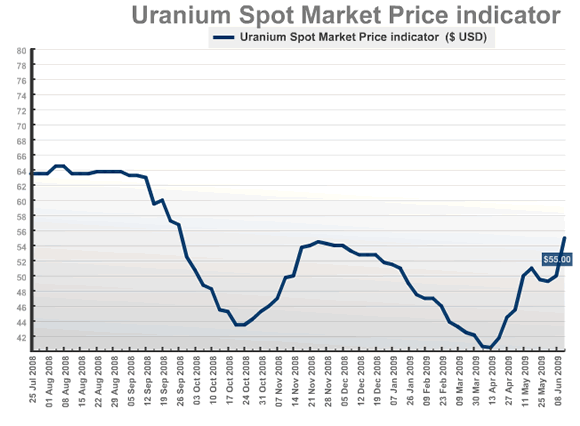
From Bloomberg
Uranium Rises to Seven-Month High as Energy Commodities Gain
Share | Email | Print | A A A
By Yuriy Humber
June 22 (Bloomberg) — Uranium rose to the highest in seven months as energy commodities gained globally and utilities sought to acquire stakes in companies mining the metal.
Uranium-oxide concentrate for immediate delivery added $3, or 5.8 percent, to $55 a pound, Denver-based pricing service TradeTech LLC said in a report dated June 19. Nine transactions totaling 1.9 million pounds in volume took place last week.
“Uranium has moved up in line with energy commodities” over the last two months, said Glyn Lawcock, head of resources research at UBS AG in Sydney. “The price got beaten up earlier this year because people needed to generate cash, but things have calmed down.”
A two-month run-up in the uranium price has taken the metal needed for nuclear fuel to its highest since November, when some financial investors including the bankrupt Lehman Brothers Holdings Inc. sought quick sales. Japan’s Kansai Electric Power Co. said last week it would seek more stakes in uranium mines to secure supplies as competition intensifies among utilities to snap up shares of producers.
Uranium has advanced 36 percent since the week ended April 10, shadowing the 38 percent climb for crude-oil futures traded in New York in the same period. Coal used to fuel power plants had gained 12 percent since April’s close as of the week ended June 12, according to McCloskey Group Ltd. prices from South Africa’s Richards Bay, site of the world’s largest export terminal for the fuel.
Weekly uranium supply and demand was about 4.5 million pounds last week, according to TradeTech, which includes offers to buy as well as actual transactions in its demand calculation.
Mined uranium provides less than two-thirds of the metal needed each year, with the gap made up mostly from U.S. and Russian stockpiles.
To contact the reporter on this story: Yuriy Humber in Moscow at [email protected]
Last Updated: June 22, 2009 06:10 EDT
Well-known and highly regarded throughout the mining and exploration community, Mercenary Geologist Mickey Fulp:
“MF: The demand is there. The mined supply every year is somewhere around 110 to120 million pounds. The current world demand is somewhere around 160 to 170 million pounds. So in terms of mine production, the world is at a one-third shortfall on a yearly basis. Over the last few years, these shortfalls have been supplied in large part by the Russians and their “Megatons to Megawatts” program, which converts highly enriched weapons-grade uranium into low-enriched uranium suitable for reactors. The Russians have stated publicly that sales to the U.S. are going to end in 2013. Currently, the U.S. uses somewhere around 55 million pounds of uranium per year and produces less than 4 million pounds. The demand obviously is there. We have not built a nuclear reactor in the U.S. for years, but we have increased the efficiency and increased units within our existing nuclear power plants, so that our demand has been going up. As an energy supplier, uranium is just about as green as you can get. It leaves no carbon footprint. It’s safe. The Three Mile Island scare was media-driven hype, and we all realize that now. Increasingly, the green sector is looking at nuclear energy as a viable, clean, alternative source in the United States.”
Read more at http://www.uranium-stocks.net/mickey-fulp-mercenary-geologist-the-demand-is-there/#more-1001
This could be interesting… and might indicate that it is time to start buying Australian uraniums again… that is if you have a time frame out a couple of years…..
