
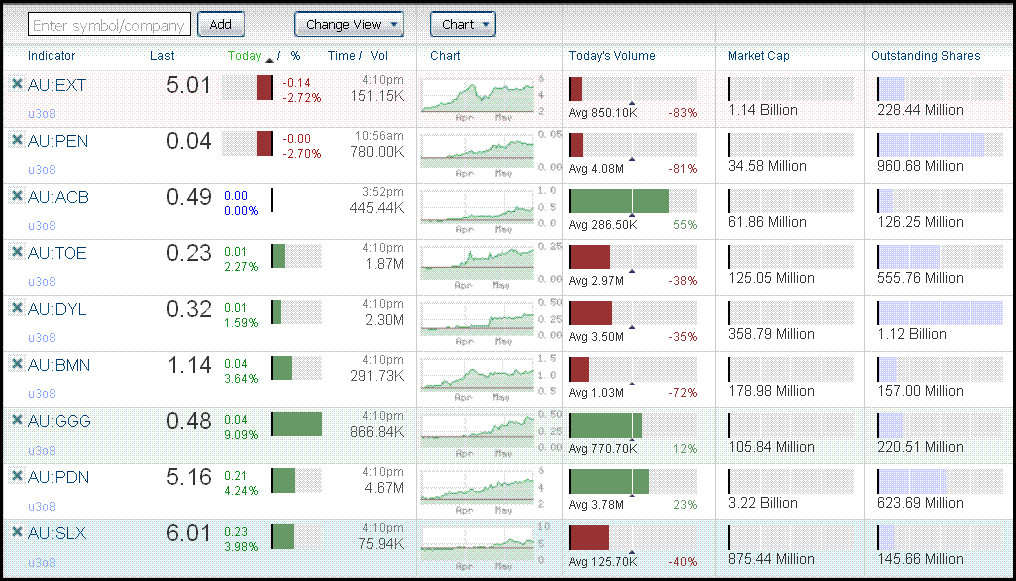
The charts on the image show the last three months. GGG is up almost 100% perhaps not suprising as they have Inferred mineral resources of 229 million pounds of U3O8, 988,000t of REO and 1.3Mt of NaF.
The others are all doing pretty well…

Posts on this website are general "tips" and nothing more than that and should never be used to make an investment or trading decision. All information should be carefully cross-checked against official sources for accuracy.
The charts on the image show the last three months. GGG is up almost 100% perhaps not suprising as they have Inferred mineral resources of 229 million pounds of U3O8, 988,000t of REO and 1.3Mt of NaF.
The others are all doing pretty well…
During Cameco’s May 1 earnings release conference call, management offered a number of interesting tidbits. First, during the big run-up in uranium prices back in 2007 the company purchased little if any uranium on the spot market. But in the first quarter of 2009 the company was a significant acquirer, as the following quote indicates:
…[W]hile we are reporting lower net earnings than [the] comparable quarter of 2008, a major component of that changes relates to opportunities Cameco finds in the uranium market. Our reason for purchasing [spot uranium] in the first quarter was for one purpose only, to seize trading opportunities which our marketing staff identified. When we enter the market to take advantage of trading opportunities, we often acquire uranium at prices significantly higher than our production cost. This action results in our reported unit cost of sales being driven higher. And of course that flows through to margins and earnings.
Cameco is simply saying that current uranium spot prices–even at recent lows–are significantly higher than its production costs. When it actively buys uranium, the cost of its inventory goes up; its cost of sales rises and depresses profit margins.
Cameco wouldn’t be making these purchases if it felt uranium prices had more downside. The company is essentially speculating that the price of uranium is likely to rise from current levels.
Because Cameco knows a lot more about the uranium market and has more perfect information than I or any other analyst does, I prefer to bet with the company. In other words, if Cameco is buying uranium, you should consider following its lead.
Another interesting comment from the company’s call relates to the source of uranium demand. Consider the following:
…I believe that about half of the purchases [of uranium in the spot market] that have taken place have been made by utilities…a good portion of that would have to be attributed to the Chinese. And in their case, they’re certainly looking to stockpile significant quantities of inventory for the Chinese program.
It seems that the Chinese utilities are also convinced uranium prices have bottomed and are likely to head higher. The Chinese have been extremely smart and strategic when it comes to locking up natural resource supplies they know they’ll need in coming years. It’s not a bad idea to follow China’s lead into uranium.
Excerpt from http://www.petroleumworld.com/sf09051601.htm
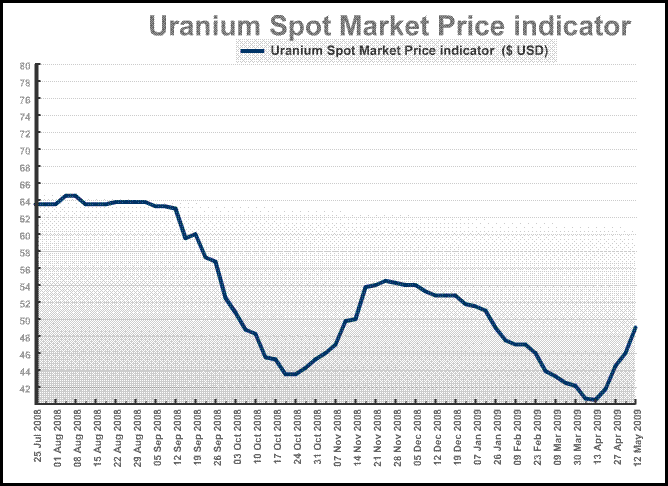
Excerpt: “Global portfolio flows indicate that among mining stocks, listed uranium names have been in strong demand over the past few months, third among mining subsectors only to specialist miners of nickel and zinc. One catalyst has come by way of spot uranium prices, moving up over the past month or so, reversing a longer term downward trend, and more recent one in place since December. ” Read article
Monday, May 11, 2009
by Melissa Pistilli
Recent market and industry reports suggest that the uranium sector may be on the verge of a new bull market cycle as the spot price for U308 rises slightly to $44 per pound. “We believe the uranium market is in the early stages of a bull market rally that could last three or four years,” says a report by RBC Capital Markets.
In the report, analyst Adam Schatzker notes that uranium equities have rebounded nearly 225 per cent, although they are still around 68 per cent under their historic peak. Schatzker believes the market is probably two years away from reaching those peaks again.
The most important factor contributing to Schatzker and other analyst’s recovery forecasts is what many see as a devloping supply/demand shortfall as nations around the world turn to nuclear power as a greener alternative to fossil fuels and utility companies move to acquire dependable supply lines. UX Consulting estimates 2009 uranium demand at 171 million to 184 million pounds with production at only 125 million pounds.
“We think the uranium market will be facing substantial deficits and that utilities will have to pay higher and higher prices to secure both spot and long-term supplies. We also believe that the longer the spot price remains depressed (e.g. below US$70/lb), the more dramatic the price run-up will be,” said Schatzker.
Speaking at the annual shareholder’s meeting last week (his last official function before stepping down), Denison Mines Corp. [TSX: DML] [NYSE: DNN] CEO Peter Farmer said he expects the spot price to increase through 2009 and to possibly “spike” as worldwide demand rises.
Others believe uranium prices could rise as much as 35 per cent in 2010 on energy demand out of Asia and Western Europe. “By historical standards, the current price is pretty high and I imagine they’ll be trying to lock in as many sales contracts as they can,” said Gavin Wendt, senior resources analyst at Fat Prophets Funds Management. “Energy will be a key commodity and especially for Asian economies.”
Another sign that the uranium market is set to rebound is the latest reports concerning mining giant Cameco Corp’s [TSX: CCO] [NYSE: CCJ] purchasing activity. On Friday, Cameco reported that its quarterly profit dropped 38 per cent on higher production costs. The rise in cost is due to uranium purchases at near-spot prices during the first quarter.
The purchases, said Cameco CEO Jerry Grandey, are a part of a longer-term strategy that will allow the company to take advantage of rising uranium prices. “Down the road, we will realize additional revenue and earnings as we deliver the purchased material to our customers,” said Grandey.
Uranium Mining Stocks
Investors are once again getting excited about uranium miners, especially those companies with viable, advanced projects. “We think consolidation in the uranium business will occur in the coming 12 months, but the number of quality names is limited and should help drive equity prices higher,” said the RBC report.
Some names making the market reports include First Uranium [TSX: FIU] and Deep Yellow [ASX: DYL]. Both have had “strong positive inflows” so far this year, according to Mineweb’s Barry Sergeant. First Uranium has had the “most spectacular price gains . . . up 174 per cent% from prices on 12 January 2009.” Deep Yellow has advanced 86.7 per cent “particularly on more recent drilling results.”
On Tuesday, shares of First Uranium on the TSX reached a 52-week high of $7.68 to close at $7.36.
Shares of Deep Yellow on the ASX closed at .28 cents, down from a 52-week high of .38 cents.
Courtesy of Uranium Investment News a leading provider of business news, financial information and analytical tools on the uranium market.
Renewed interest in Uranium and REEs…. Is this the best value play? IMO yes.

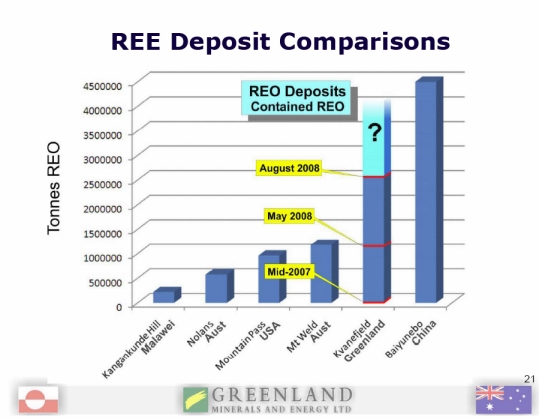
The chart below is taken from ASX listed GGG’s website the company that (ASX Code:GGG) own’s the Greenland deposit. It is from mid 2008. GGG has large amounts of uranium and REEs.
The reason I posted it is to show that Australia is in a good position vis a vis China re dominance in the REE industry. See http://www.australianrareearths.com/current-issues.html

The Kvanefjeld REE deposit in southern Greenland is growing rapidly to become one of the largest deposit of REEs in the world. It has the potential to meet the world’s rapidly growing demand for REEs, and in doing so, can become a major contributor to the Greenland economy for decades to come. At Greenland Minerals and Energy, we believe that Kvanefjeld will be truly world class mineral deposit that can be developed in a responsible, environmentally conscious manner, to become one of the world’s major sources of Rare Earth Elements – “Specialty Metals for a Greener World”.
GGG has almost as much uranium as EXT. Plus they have 2/3 more value in their Rare Earth Element… the looming battle ground for the move to the electron based economy. So for a very small market cap of around $35m you get 200m pounds of uranium and one of the world’s largest REE deposits.
Globally there are 436 reactors in operation today, annually consuming some 168 million
lbs. of uranium to produce 16% of the world’s electricity. A further 151 new reactors
are either under construction or planned, plus 266 more units proposed. Adding only
those being built or planned would yield a dramatic 35% increase in the number
of plants worldwide. If we simplistically assume the average new reactor consumes
as much fuel as those currently operating, the industry must source an additional
59 million lbs. of uranium per year on an ongoing basis — and likely within the next
decade. This represents a staggering 55% increase in mine output from today’s levels.
Moreover, the startup of a new reactor causes a surge in demand as initial cores
typically require 2–3 times annual requirements during the ramp–up phase.
Where will all this uranium come from? Is it even possible?