Announcement:

Posts on this website are general "tips" and nothing more than that and should never be used to make an investment or trading decision. All information should be carefully cross-checked against official sources for accuracy.

More – Putting AEE into perspective….

April 18th, 2011

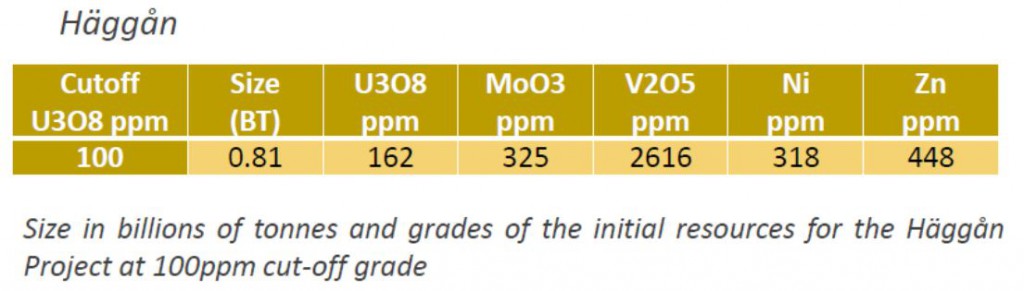
Aura’s Häggån project is amongst the ten largest uranium resources in the world, yet the existing JORC first inferred resource of 291 million pounds of uranium (U3O8) is based on only 5% of the permit area, mainly in the eastern side, highlighting the projects resource upside potential.

AURA has just completed an 11 hole drilling program and we can probably be sure of a rather large upgrade…. All up the project is thought to have over a billion pounds of uranium… see earlier posts.

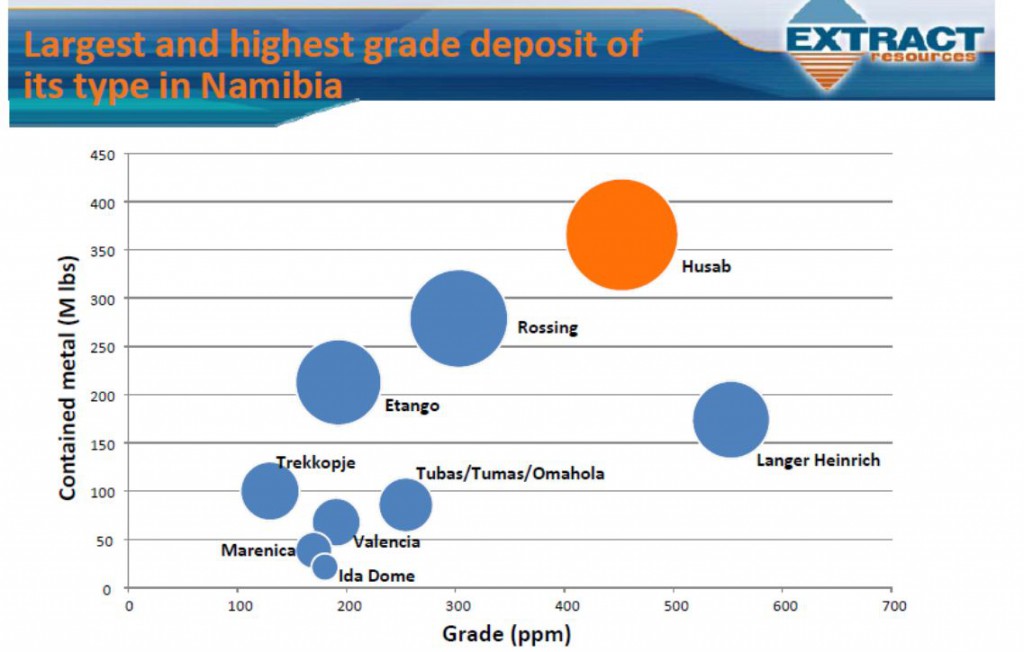
Extract -World's 2nd largest Uranium mine 5th largest Uranium resource

April 15th, 2011

hsuab

Husab Project Update

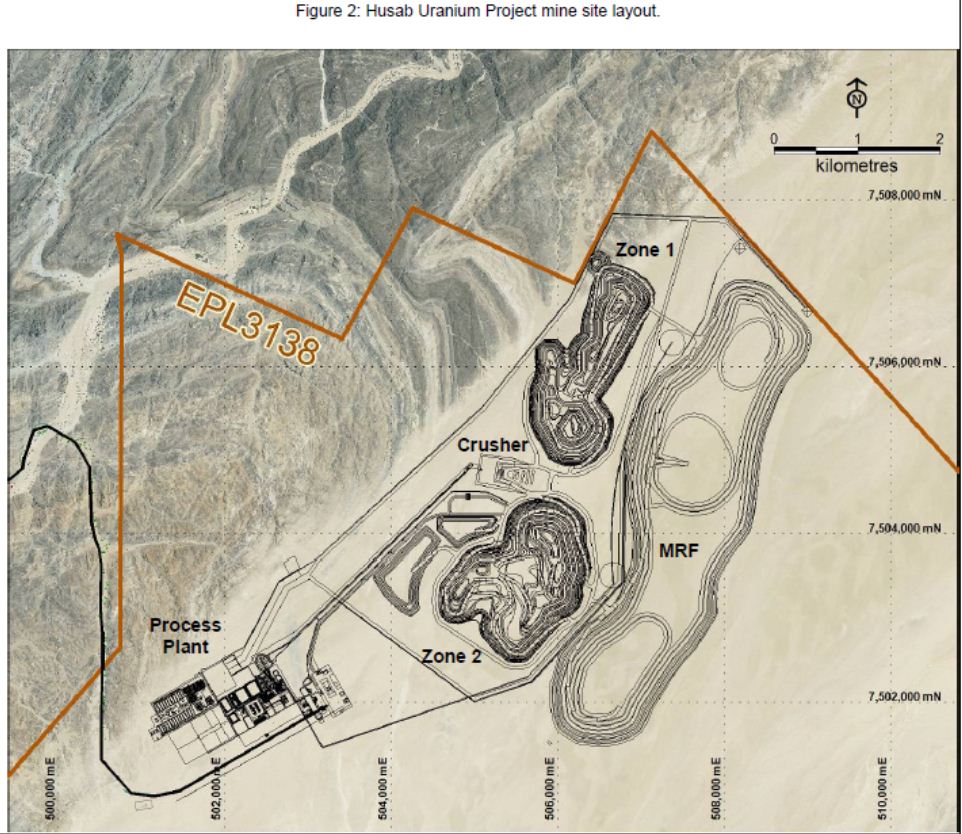
Completed Definitive Feasibility Study on Zones 1 and 2 (DFS) of the Husab Uranium Project, which will become one of the three largest uranium mines in the world.
Maiden reserve estimate for Zones 1 and 2 of 205 million tonnes at 497ppm for 225 million lbs contained uranium.
Significant upside potential from Mine Optimisation and Resource Extension (M.O.R.E.) programme. Next resource update scheduled for Q2, 2011.
Outstanding initial chemical assay results received from Middle Dome highlighting this prospect as a priority exploration target.
Approval of Husab Uranium Project EIA received in January 2011.
EPL 31838 exploration license successfully extended for two years.

Corporate

CGNPC- URC announced a possible cash offer for Kalahari Minerals, our major shareholder. The Australian Securities and Investments Commission (“ASIC”) expected to respond shortly to CGNPC’s request to seek a waiver to acquire more than 20% of Extract’s issued share capital.
Partnership process continues to evaluate opportunities to add value to the Husab Uranium Project through alternative development strategies.
Extract raised $60.9 million by a placing of 7.3 million shares to Kalahari Uranium Limited, a subsidiary of AIM listed Kalahari Minerals Ltd.

Putting Aura into perspective

April 14th, 2011

In the post below this one I made the case for AEE being a vastly undervalued uranium company and highlighted the new high grade African resources….

To round out the story here are some images from AEE’s latest Investor Presentation.. Note that I hold AEE as it fits well inside my paradigm of an undervalued elephant with a vast resource and a micro- market cap (AUD$48m)… Perhaps readers should note that Extract Resources market cap is over AUD$1billion…

aee-in-context

aee-2

Is there built in demand for Uranium?
uranium-reactors-under-construction

I suggest that readers download the latest AEE Investor presentation and look at their metallurgy results etc. (A 12 hour heap leach process, in a very friendly mining jurisdiction in a country that has a 50% reliance on nuclear power in a geologically stable area and a vast upside to the JORC resource and a miniscule market cap of $48m…..)

I hold AEE

Aura Energy -High Grade results

April 11th, 2011

Aura Energy is an extremely undervalued ASX listed small cap with a vast amount of Uranium. Aura’s JORC in Sweden places in our top 5 but this substantially underplays Aura’s resource that may be around 10 times bigger… than shown in the image below. (see posts by Sparty)

And now Aura is coming up with very high grades in several of its Mauritania leases…

HIGH GRADE URANIUM RESULTS CONTINUE IN MAURITANIA
HIGHLIGHTS
Aura Energy has received further assays for its major resource drilling programme in Mauritania.
• Positive results continue to confirm the extensive nature of the calcrete uranium mineralisation within the Reguibat Project
• High grade intercepts received (drill hole locations Table 1), including:

    o 10ASACI080: 3.0m @ 2268 ppm U3O8
    o 10ASACI084: 2.5m @ 1859ppm U3O8
    o 10ASACC079: 10m @ 2000 ppm U3O8
    o 10FEACA043: 2.5m @ 1787ppm U3O8

• Mineralisation starts at or is close to the surface
• JORC resource on track – expected in mid-2011

aee-mauratania

With a market cap of AUD$40m this makes Aura the cheapest uranium play on our ASX and possibly the world’s cheapest if we are looking at very large resource based companies…..

Extract up on positive BFS

April 5th, 2011

Extract has released 3 announcements to the ASX today.

2 are addressed to explaining the BFS and the other to the extension of the EPL 3138 license term.

In a nutshell EXT has come up with production costs of $28 per pound and a yearly production of 15Mlbs using a conventional acid heap leach process.

The projects attractions are probably best seen by a glance at the image below…

dfs-largest

Previous posts about Extract

I hold EXT.

Take your Uranium dollars off-shore

March 30th, 2011

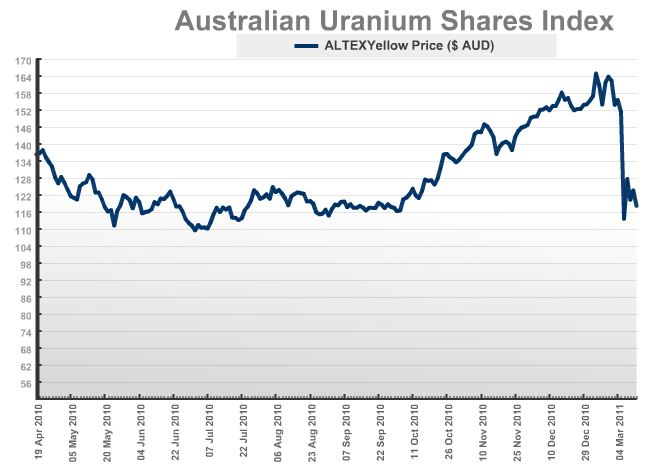
In view of the looming Green dominated senate and the marked drop across our ASX uranium plays that have on-shore projects, I believe that it is probably sensible to take your money off-shore via our overseas listed explorers…

Other than Paladin we have a couple of ASX minor uranium producers overseas…..

au-u3o8

Just in:
“The Greens are warning a number of regional communities will be put at risk if a planned project to transport uranium through Western Australia’s goldfields is approved
Read article.”

Japan relies on nuclear power for about 30% of its electricity: Is there another choice?

March 30th, 2011

Japan relies on nuclear power for about 30% of its electricity. It has few natural resources and imports large quantities of coal, gas and oil at an ever increasing cost. Some Japanese people are not in favour of nuclear power, but when the dust settles the nation might not have any real choice.

Losing four old reactors at Fukushima that were due for replacement is not the end of the world, and certainly not when you consider the huge loss of life and enormous damage wreaked by this month’s earthquake and tsunami.

Japan’s reactors

Japan built its 55 nuclear reactors over a period of decades (the damaged reactors in Fukushima are some of the world’s oldest still in regular operation, based on early commercial designs).

Nineteen began operation in the 1970s (Fukushima-Daichi-1 dates from 1971); fifteen began life in the 1980s; thirteen in the 1990s; and five in the “noughties”.

Of course, one might question the logic of building reactors in earthquake zones, but in the end the primary reactor structures in Fukushima were not directly damaged; nor have they been damaged in previous quakes.

One could also ask what would have happened to other sorts of power stations (particularly dispersed ones such as wind farms or solar cell arrays) in such an event. My guess is that they all would have been swept away.

Some context

All thermal power stations are based on similar principles: they produce heat by burning something (coal or gas for example) and convert the generated heat to electricity.

The big advantage of using nuclear reactions such as fission is that one fission produces about 100 million times more energy that you get from burning a single carbon atom.

Coal-fired power stations have to burn a lot of material (about three million tonnes a year) to generate electricity for a city of a million people, and about 10 million tonnes of carbon dioxide are released to the atmosphere in the process.

Nuclear reactors, by comparison, consume only one tonne of the fissile uranium isotope, U-235, to deliver the same.
Some numbers

There are currently 441 large nuclear power reactors in 35 countries, 120 of which date from the 1970s and early 1980s.

Collectively the 400-odd reactors supply about 15% of the world’s electricity (the average in OECD countries being more than 22%). So far they have racked up more than 14,000 reactor-years of operation.

The United States has the greatest number operating, with 103 units providing 20% of its electricity supply; this is followed by France with 57 (producing nearly 80% of its supply) and Japan, with 54 (providing about 30%).

With a lifespan of approximately 35 to 40 years, some have pointed to the fact a nuclear station decommissioning “peak” will occur from 2020 to 2030, and that this will present technological and environmental challenges. In my opinion these challenges will be met.

Reactors worldwide

Of the reactor types, 22% are either Boiling Water Reactors (BWR) or Advanced Boiling Water Reactors (ABWR) while 62% are Pressurised Water Reactors (PWR) of different hues.

Most of the remaining reactors are the Canadian designed CANDU systems (or their derivatives in India) that operate with heavy water and natural uranium, or the AGR (graphite moderated, gas cooled) reactors developed in the UK from the early Magnox (metal fuel) reactors.
Modern designs

Newer models (those you would buy off the shelf if you went shopping for one today) are more modular, smaller, simpler with fewer pumps and valves etc., and they have what are called “passive” safety features.

These features are very important because they mean that you can continue to cool the reactors, even if you lose all electricity supply.

Dramatic advances in computers in the last two decades have also had a major impact on the control systems for reactors, improvements that are gradually being retrofitted to existing reactors, expanding their ability to diagnose and cope with issues that might occur through foreseen or unforeseen circumstances.

This will have a significant impact on the training of reactor staff, who already have available to them full-scale simulators that mimic real and imagined events, and on the capacity of the industry to share technological information.

The standardisation to a few reactor designs will also help the move towards international oversight and analysis of safety issues and approval of designs; this in turn will take some of the burden off individual countries that might be temped to reinvent the wheel.

What happens now?

Of course, the ongoing Japan crisis is not an easy situation to deal with and will doubtlessly have repercussions for the entire nuclear industry. Already, countries with significant nuclear installations are looking at the age of their fleets in the light of what has happened here.

Germany, which gets about 28% of its electricity from reactors, has paused operation of its older reactors until they can be re-evaluated.

China has temporarily stopped construction of the many new reactors it has on its drawing boards – currently 34 approved with work on another 26 initiated – and the UK is going to look again at its plans.

But the likely result of these and similar actions in other countries is a pause, rather than a cancellation of nuclear reactor production.

The Chinese government, for example, might worry that it cannot meet any of its carbon-emission targets without a large-scale low-emissions technology such as nuclear.

The needs for stable large-scale electricity supplies and lower carbon emissions are issues that won’t go away easily, not for any nation.

Nuclear has long been part of the solution, and I believe this remains the case.

From http://theconversation.edu.au/articles/nuclear-will-survive-because-it-has-to-395

Uranium watch shows the future is still nuclear

March 27th, 2011

The dangers of Nuclear power plants as mass killers seems to be a popular viewpoint at the moment but the facts actually point the other way… A recent article in the Australian Doctor reviewed the factual information following the Three Mile Island incident and states that it resulted in 1-2 deaths from released radiation within a 16km radius of the reactor.

Today’s article in the SMH is interesting in this context….

James Kirby
March 27, 2011

TWO weeks after the biggest nuclear crisis in a generation and a leading item on ABC radio news is that three workers have been taken to hospital in Japan for radiation treatment. Meanwhile, the toll from the Japanese earthquake and tsunami (killed or missing) is more than 27,000.

You might say that setting the radiation statistics at the still-dangerous Fukushima nuclear station against the wider disaster toll in Japan is meaningless … the story is far from over.

But what would be meaningful? Let’s pit the reported radiation casualties in Japan against other casualty lists in alternative forms of energy. For instance, the number killed in coal mines: in China alone, the official estimate of fatalities inside the national mining industry is more than 2000 a year.

Yes, the future of nuclear energy is under immediate review but a number of indicators suggest that the review may turn in a surprising direction. Read more