Announcement:

Posts on this website are general "tips" and nothing more than that and should never be used to make an investment or trading decision. All information should be carefully cross-checked against official sources for accuracy.

Aura ASX: AEE Häggån’s C1 cash cost is estimated at *$13.50 per pound U3O8.

August 6th, 2013

HÄGGÅN – A GLOBALLY SIGNIFICANT AND STRATEGIC URANIUM DEPOSIT
REGUIBAT HAS THE POTENTIAL TO EMERGE AS AN EARLY CASHFLOW PROJECT
LOW COST PROJECTS ARE THE ONLY VIABLE OPTION FOR THE CURRENT URANIUM MARKET
Following the recent Board changes Aura Energy Ltd (ASX: AEE) has reviewed the company strategy with a key focus on improving the recognition and value of its globally significant uranium projects, and creating steps to shorten the development timeframe for these projects.

Under the direction of Managing Director Bob Beeson and his geological team, outstanding success has been achieved with the discovery of both the Häggån and Reguibat uranium projects. Today Häggån is ranked as the second largest undeveloped uranium deposit in the world.

Faced with the challenge of Häggån’s lower than average grade, Aura’s metallurgical consultants – lead by Director Jules Perkins, previously Chairman of the Parker Cooperative Research Centre for Hydrometallurgy – has managed to successfully create a key processing breakthrough for the deposit in the form of bioleaching. The significance of this breakthrough and the fact that it potentially positions Häggån at, or close, to the bottom of the uranium cost curve, cannot be underestimated.

Häggån’s C1 cash cost is estimated at *$13.50 per pound U3O8.

The Aura Board maintains that the Häggån project is an extremely robust project and largely immune to the current low uranium price. This makes the large Häggån uranium resource a unique deposit of long term strategic importance to Sweden and the European Union.

It is the intention of Aura Energy’s Management and Board to work assiduously over the comingThe Strategic Review concluded that the bioleach testwork for Häggån is sufficient for the current level of study to confirm the exceptionally low Scoping Study operating cost. Bioleaching is the most efficient process for the deposit, and the leaching operating cost is the most important element of the Häggån cost structure. As such this work has provided the Aura Board with a strong degree of confidence in the overall Scoping Study C1 cash cost.

In the current uranium market the Aura Board believes the only viable strategy for the development of uranium projects is to focus on those projects with the lowest operating cost. (Häggån’s C1 cash cost is estimated at *$13.50 per pound U3O8.)

The uranium sector has a range of projects which at this stage appear viable only at significantly higher uranium prices. The Scoping Study conclusions suggest that Häggån as such is unique as the combination of its large size and low operating costs, strengthening its claim for development.

Aura’s key strengths:

Häggån as the second largest undeveloped uranium deposit in the world, and

Häggån’s low operating cost positioning Aura as potentially the world’s lowest cost uranium producer.

The other key points from the strategic discussions were;
 The Board reaffirmed the significance of the Häggån Project in terms of it potentially being one of the highest margin projects in the world. The Häggån Project remains Aura’s top priority.
 An opportunity exists for Reguibat to produce early technical and development results and hence early cash flow, dependent on funding. The management team will pursue opportunities to evaluate these options.
 The Board recognises that the strong attributes of Aura, particularly Häggån, are not recognised broadly in both the equity market generally, particularly offshore, or with large corporates in the energy sector.
 Aura is developing a programme to correct the company’s perceived lack of market and corporate awareness.
 The nature of the Häggån Project – large resource, flat-lying, low strip ratio, bio heap leach processing, creates options for development at a number of scales. The management team will review the project scale with an initial concept of 3-5 million tonnes per annum to assess the potential benefits of this lower capital cost approach for early development.
 Sweden is a mining friendly country which derives 50% of its electricity from nuclear power. However, Häggån’s significance is not widely recognised within Sweden and this will be corrected with additional in-country work. More dedicated work in the local community will also be undertaken.
 Reguibat is flat-lying resource at surface, with the potential for beneficiation upgrading; different scale start-ups will be considered to examine early development options.
 In all projects significant exploration upside exists, providing scope for ongoing resource expansion and/or discovery success

Should Australia's manufacturing future be nuclear?

June 6th, 2013

By Gennadi Kazakevitch, Monash University

It is not the first time in Australia’s economic history that a prevalent sector reaches its peak and gives way to a rapidly developing new one. However, while the mining and education sectors have apparently hit their peaks and manufacturing continues its decline (as seen by the planned withdrawal of Ford in 2016), there seems to be no replacement underway.

There is another possibility – albeit a controversial one. Could – and should – Australia embrace the manufacture of nuclear fuel?

More specifically, could the fabrication of nuclear fuel elements or fuel rods used in nuclear power generation plants, replace our current export of uranium oxide concentrate – so-called “yellowcake”?

Australia exports nuclear fuel anyway. It is just the matter of doing it smarter and safer, adding more value to Australia’s product before it leaves our shores, while creating more jobs for Australians and making the world more secure.

What is the reason Australia has not done this so far? Firstly, the countries capable of exporting fuel elements, such as France, historically started their fuel element fabrication industries intending to generate nuclear-based energy for themselves.

Having abundant and easy to mine coal deposits, Australia did not have to bother about the nuclear industry. Secondly and more importantly, the nuclear industry is strictly (and rightfully) regulated. Even mining uranium ore is a very controversial and politically charged matter.

To start producing fuel elements, a company must lobby federal and state governments; while for governments a huge task would be to face hostile anti-nuclear public opinion. Therefore, a vision and leadership is needed from the governments’ side to support any commercial interest in this industry.

Potential market capacity

Most of the yellowcake used for power generation worldwide is produced by 17 nations. Australia is the third largest producer after Kazakhstan and Canada and meets about 20% of the world demand.

Of the producers – Canada, the United States, Germany and France – Australia is the only developed nation producing yellowcake that does not fabricate fuel rods. However, Germany and France produce only miniscule amounts of yellowcake and import considerable amounts of it for their domestic production of rods.

Among growing energy markets, the largest – in absolute terms – potential growth of nuclear energy sectors is expected in India and China.

The World Nuclear Organisation predicts – for China alone – five-fold increase to 58 GWe (Gigawatt) by 2020, to 200GWe by 2030, and to 400 GWe by 2050.

To put this numbers into perspective, each existing or new nuclear-powered generation facility is or will use approximately 27 tons of the material – ready for nuclear fuel rods – per year per each 1 GWe of generation capacity, which – in current prices – is transformed into at least $40 million per year per 1 GWe of the yearly generation capacity.

Both China and India, currently have very small uranium mining and fuel rod industries compared to their current and future demand. Both are resource-hungry and would consider increasing imports of either yellowcake, or fuel elements, or both. Therefore, the growing market demand can be met by developing Australia’s own fuel element manufacturing industry.

So then, if established in Australia, to what extend would this industry be sustainable? Unlike yellowcake, fuel elements are normally fabricated to particular specifications of generation plants. Therefore, once established, producer-customer links are potentially for the life time of the generation facilities.

Australia already exports yellowcake, or uranium oxide. Flickr/Uranium Energy Corp

Adding value and employment

The nuclear fuel element fabrication industry is capital, skill, and knowledge-intensive. It might add considerable value to the Australian export of nuclear fuel. It might help better utilising this country’s comparative advantage of abundant uranium deposits (up to 40% of known deposits in the world).

There are several stages of the very sophisticated process of nuclear fuel elements fabrication. All the stages require huge investments in industrial design, construction and equipment. This can be a boost for the building and engineering sectors with flow-on effects on research and development, education, training and other services and on the overall economy. This will boost the employment of the very extensive building stage and will maintain jobs at the fuel element fabrication stage.

Safety

Many Australians have developed an “allergy” to the very idea of the nuclear industry in this country. There are different schools of thoughts. Some people don’t believe this industry can be safe at all, remembering well-known nuclear catastrophes in the former USSR and the most recent one in Japan. Others refer to the positive experience of such countries as France, Germany, Finland and Sweden and believe that the nuclear industry is cleaner and safer than any fossil fuel-based one.

Meanwhile, the general public is not very aware that mining uranium ore and the fabrication of nuclear fuel elements – from the relatively simple stage of yellowcake to the very sophisticated stage of fuel rod manufacturing – is the safest part of the nuclear energy technology with a relatively low radioactivity of materials. The major nuclear disasters have actually happened at the power generation plants; while the nuclear energy industry learns a lot from every disaster and develops considerably more advanced safety technologies and procedures.

Importantly, the mass of the nuclear fuel enriched for and locked in fuel elements is about 25% of the mass of the yellowcake used. Therefore, the logistics of transporting new (unused) fuel rods is cheaper and safer than of current operations with yellowcake.

Concerns weapons can be made from nuclear energy programs are justified. But fabrication can help make this more difficult. AAP

International security

One of the concerns related to the nuclear energy is a possibility of proliferation of nuclear weapons. Once imported, yellowcake can be potentially used for both power generation and nuclear bomb manufacturing. The processes of transforming yellowcake into a weapon-grade material can be concealed. That is why, each new country willing to import nuclear materials and start their nuclear energy industry should be a signatory to the Nuclear Non-Proliferation Treaty. However, international control is still needed, but cannot be always effective.

Meanwhile, custom-made fuel elements cannot be so easily diverted to weapon manufacturing and delivering rods to designated power generation plants can be more effectively controlled.

Furthermore, converting the yellowcake export into the fuel elements one, considering this country’s potential power in this market, can give Australia a strong argument for replacing (where possible) the international movement of yellowcake with custom-made fuel elements.

Establishing this new industry in Australia would need the Federal and state governments working together with the industry and the public. The governments need to reconsider the licensing regime. And it is important the public realistically weigh the risks against its potential benefits. Utilising this country’s comparative advantage is imperative in maintaining the high living standards Australians have become used to. And the argument is there that the potential new industry is sufficiently safe.

Perhaps the time has come for Australians to reconsider their nuclear stance.

Gennadi Kazakevitch does not work for, consult to, own shares in or receive funding from any company or organisation that would benefit from this article, and has no relevant affiliations.

The Conversation

This article was originally published at The Conversation.
Read the original article.

For quite some time we have been pushing the case for Australia to have a “cradle to grave” uranium solution (see below) and it is pleasing to see such a well researched and written article addressing the subject.

AEE's Häggån Project now the second largest undeveloped uranium resources in the world

October 31st, 2012

HIGHLIGHTS

  • Aura holds 853 Mlbs of uranium in inferred resources at its two main projects, Häggån (Sweden) and Reguibat (Mauritania) Häggån Project, Sweden
  • The company has completed the first phase of its strategic review of funding and development options.
  • Initial Exclusivity Agreement signed with potential strategic partner in August 2012
  • Second, superior offer received in October
  • New 3 month Exclusivity Agreement now in place
  • Häggån inferred resource expanded to 803 million pounds U3O8 at a grade of 160ppm
  • Häggån Project now the second largest undeveloped uranium resources in the world
  • Additional exploration target* of 440 to 840 million pounds U3O8 defined, demonstrating potential for significant additional resource increases
  • Work continues on pre-feasibility study planning Mauritania, West Africa
  • Removal of coarse material of Reguibat mineralisation increases grade of the product by a factor of three to 1,068ppm U3O8
  • Opportunity for significantly reducing material volume and increasing uranium grade, which may lead to reduced capital and operating costs

More to come:
With additional drilling, the resource base may increase by almost 100%. This potential quantity and grade is conceptual in nature and there has been insufficient exploration to define a Mineral Resource. It is uncertain if further exploration will
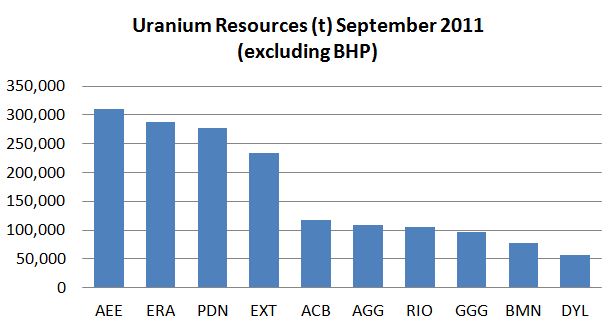
result in the determination of a Mineral Resource.aee-contained-metal

AEE in terms of Mkt Cap/Resources is now Australia’s cheapest uranium.

Aura Energy gets second suitor

October 30th, 2012

An interesting development for ASX: AEE the owners of the world’s 3rd largest undeveloped uranium resource. Having worked out their flow sheet etc AEE needed a big brother to take them into development….Yesterday’s announcement not only shows that they will have little trouble going forwards re funding but in my opinion that uranium is again becoming a sort after resource.

Significant new development in the Häggån Funding Strategy
29 October 2012

Aura has received a second, superior offer from a global miner

As announced to ASX on 14 August 2012, following completion of the first stage of its strategic review, Aura Energy (ASX:AEE) signed an Exclusivity Agreement with a major uranium market participant, in respect of a potential strategic partnership for the Häggån uranium and polymetallic project in Sweden.

Subsequently, an unsolicited proposal was received from a second potential partner (“New Proposal”), which the Board has assessed to be superior to the first proposal. The second party is also a major uranium market participant.

Consistent with the fiduciary carve-out contained in the original Exclusivity Agreement, the Board now intends to engage with the second participant in relation to the New Proposal.

A new 90 day Exclusivity Agreement has been entered into with the second party, during which the parties will attend to outstanding due diligence and negotiation of definitive documentation in relation to the New Proposal.

If agreed, under the New Proposal the Strategic Partner would make an initial cash payment to Aura on formation of the Strategic Partnership, and would provide funding for further feasibility work at Häggån, in return for equity in the project in two phases.

It should be stressed that discussions remain at any early stage and there can be no assurance that a binding agreement will be executed. Aura will provide further updates on the process in due course. In the meantime, Aura remains focused on advancing its suite of uranium assets in Sweden and Mauritania.

Deferral of ~45mlbs per annum Uranium production good for near term mid tier producers?

September 13th, 2012

I expect that we will see a significant bounce in our near term new uranium producers on the back of BHP’s et al reduction/deferral of ~40m-45mlbspa U3O8. We should also see a bounce in similarly placed copper producers and as such BHP’s deferral of its expansion of Olympic Dam could turn out to be a much needed boost for our mid-cap uranium and copper producers. I also think that Australia’s on-shore uranium plays will not get a new mine into production within the next few years and that makes me think we should be looking at off-shore uranium mining friendly countries and fortunately we are more than well endowed with ASX off-shore elephantine uranium plays with great prospects for near term (< 5 years) production. Copper producers should find it much easier and of those about to produce CDU, AOH and a couple of others look to be more than a little interesting.

Aura Energy (ASX: AEE) now world's second largest undeveloped uranium resource

August 22nd, 2012

Please note that this entry was posted in 2012. Since then AEE has markedly improved its benefaction and processing and its market cap is 1/4 of what it was. More info at http://www.auraenergy.com.au/

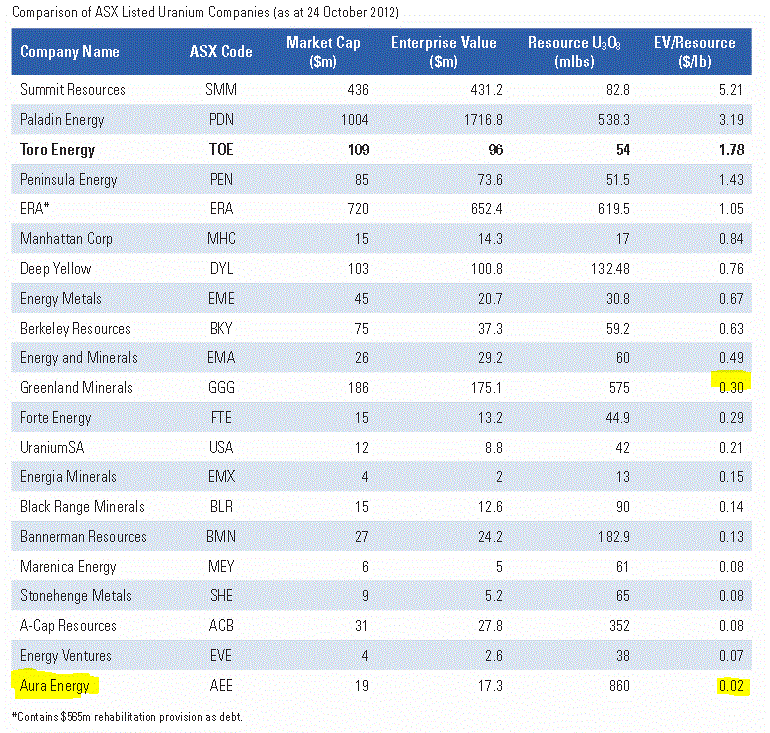
For quite some time now I have been banging the drum for ASX micro-cap AEE based on its EV:Resource ratio. Today’s ASX release confirms my expectations and the figure below shows why. See earlier posts re AEE

haggan-now-second-largest

Drilling that has been used in this resource statement covers only 25% of Aura’s permit areas at Häggån. The majority of Aura’s permits in the district remain untested.

Market Cap = $22m placing AEE as one of the cheapest uranium plays in the world. Adding to this is AEE’s extensive and successful mineralogy with a rapid turnaround heap leach process.

uranium-comparisions-asx-aee-highlighted

Please note I have highlighted Aura Energy and Greenland Energy and Minerals. As you can see AEE has an enterprise value / resource ratio of 0.02 whereas  Greenland Energy and Minerals is  0.3.  What needs to be recognised here is that Greenland Energy and Minerals has the world’s largest rare earths resource in the same Kvanefjeld deposit. (Aura also has co-credits of Mo, V2O5, Zn)

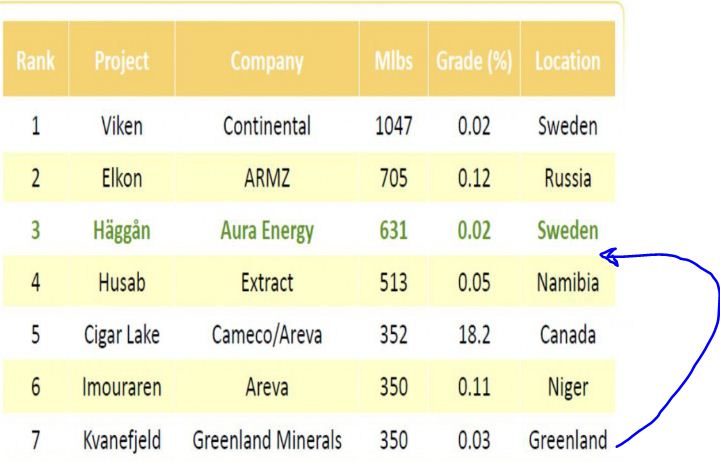
GGG moves up to world's 4th largest undeveloped uranium resource

June 6th, 2012

Greenland Energy and Minerals (ASX code: GGG) “Highlighting the exploration upside and sheer scale of GGG’s project, the new Zone 3 resource increases the global metal inventory at the project to a 575 million pounds of uranium, 10.3 million tonnes of TREO, and 2.24 million tonnes of zinc.”

The rare earth resource inventory includes 370,000 tonnes of heavy REO, and 840,000 tonnes of Y2O3.

Read about maiden JORC Resource for Zone 3 pdf

Image shows world’s largest undeveloped uranium resources.

ggg-550-uranium

Aura Energy to have one of world's largest, lowest cost uranium mines

May 29th, 2012

Today’s announcement by Aura Energy has been summarized by www.miningnews.net and I will reproduce their opening statement:

“AURA Energy is looking for a partner to develop what may emerge as one of the world’s largest and lowest cost uranium mines at its Häggån project in Sweden following a revised and independent scoping study.”

In essence AEE has one of the world’s largest uranium resources in Sweden a mining friendly, low sovereign risk country. And at the moment with a market cap of ~$22m it is a bargain. The recent sales of uranium projects, with viable resources have been around $8 – $10 per pound. AEE’s Haggan project is viable, the mineralology and processing flow sheet has been defined and consequently AEE is absurdly under-priced.

Aura Appoints Corporate Advisory Firm

May 11th, 2012

Aura Appoints Corporate Advisory Firm

  • Leading independent Australian investment house Gresham Advisory Partners
    appointed as corporate advisers
  • Mandate to focus on identifying appropriate opportunities for the Häggån project

Aura Energy (Aura, ASX: AEE) has appointed leading independent Australian investment and advisory
house Gresham Advisory Partners Limited (Gresham) as a corporate advisor to the company.
The recent release of Scoping Study outcomes for the Häggån Project in Sweden has led to an increase in
expressions of interest in the Project from a number of significant participants in the uranium sector.
In light of these developments the company has decided it prudent to enlist the support of a leading
independent corporate advisory firm to assist in the consideration of opportunities to maximise
shareholder value.

Gresham has extensive experience in and an understanding of the uranium sector locally and
internationally. Its mandate extends to review a number of alternative development and funding
strategies for Häggån.

Under the terms of the appointment, Gresham is to be granted 1,000,000, three-year unlisted options
over new shares in Aura at a strike price of $0.20.

The company will advise the market of relevant developments in relation to the funding of Häggån in due
course. In the meantime, Aura remains focused on advancing its suite of uranium assets in Sweden,
Mauritania and Australia. Ends

As I have been predicting it seems that Australia may well lose one of the world’s largest uranium deposits and even at 20c per share it will still be one of the world’s cheapest in terms of EV/Resource.

World's cheapest uranium play in play